

Students can match a word to its definition on Tuesday and have no use for it by Friday. A definition copied from the board or a worksheet gives them one brief encounter with the word, and most students need many more than that. This article collects strategies for teaching academic vocabulary that fit into a normal teaching week without hours of prep, and it rates each one by how much it gets students to use the word themselves.
Each strategy below carries a student-use rating: low, medium or high. The rating reflects how much of the talking, writing or choosing the student does. A strategy rated low is still worth using, but it needs a partner that gets students producing language.
Why students know the words in a lesson and still lose them by Friday
A word stays with a student when they meet it more than once, in more than one form, and have to do something with it. Seeing it on a slide is one form. Hearing it in a clip, saying it to a partner, writing it in a sentence and sorting it in a game are others. Each form uses a different route to memory, and each gives the student a new reason to think about what the word means.
Academic words make this harder than everyday vocabulary. Words like analyze, evidence, factor, compare and region rarely come up at home or in casual conversation, so school may be the only place students hear them. For English learners, the words also have to be understood, pronounced and placed in a sentence in a second language. If the only exposure is a Monday definition, there is very little to hold onto.
The fix is repetition with variety. The seven strategies below are quick to set up, and the last section shows how to stack them across one unit so every key word comes around several times in a single week.
Word walls that students actually use, not just look at
Student use: low on its own, high when students are sent to it.
A word wall that lists words in a neat row mostly decorates the room. It becomes a working tool when students have a reason to look at it during a lesson.
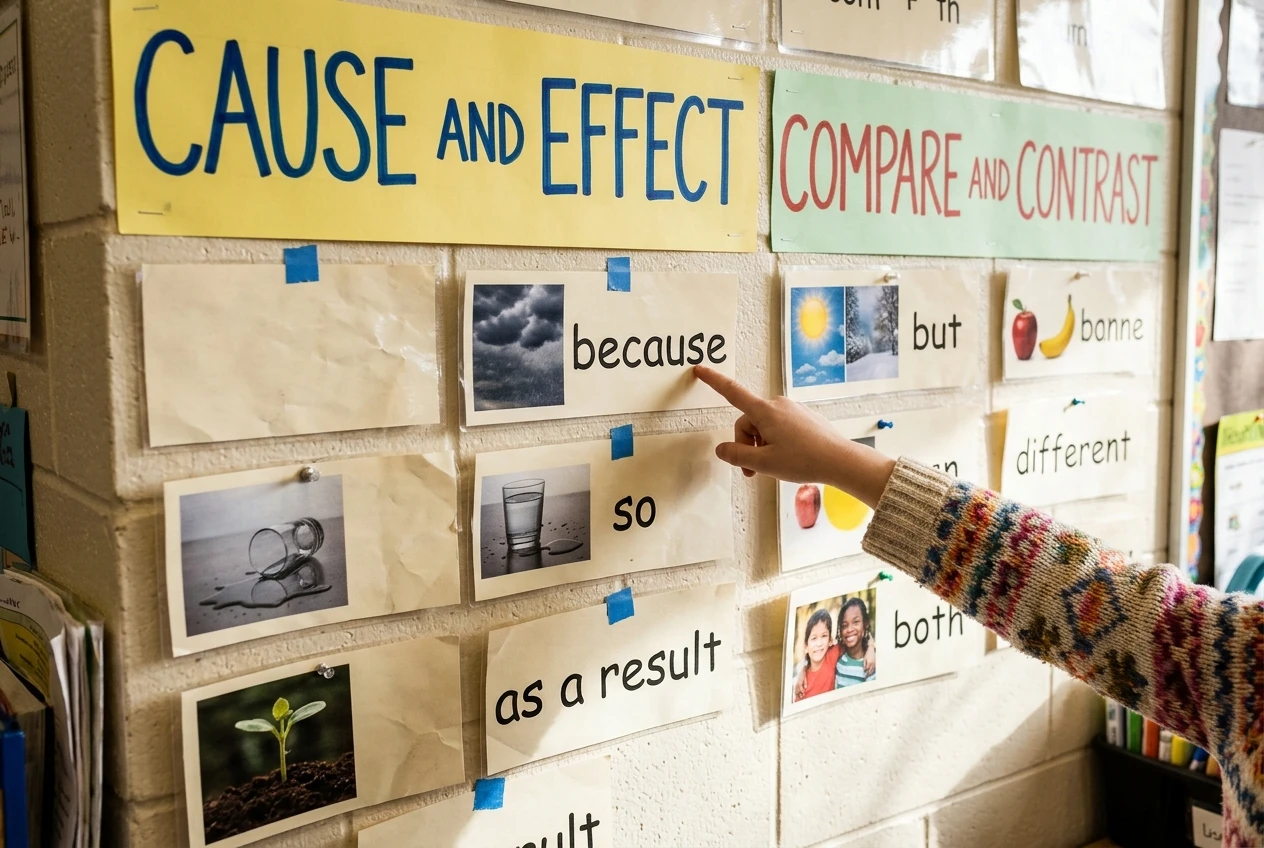
A few changes make that happen:
- Add words as you teach them, not all at once before the unit. Students watch the wall grow and connect each new word to the lesson where it appeared.
- Group words by meaning or topic rather than alphabetically. Words for describing cause and effect sit together, for example, so students can find the right one when they need it.
- Add a small image or a short student-friendly phrase beside each word, so the wall still helps a student who cannot read the definition yet.
- Point to it in your own talk. When a student says “the thing that made it happen,” send them to the wall to find a more precise word.
- Require it in discussion. A sentence starter such as “Choose one word from the wall to use in your answer” turns looking into using.
The last two habits matter most. A word wall that you never refer to will be ignored by the students too.
Picture vocabulary: pairing each word with an image students help choose
Student use: medium.
An image gives a student a meaning that does not depend on reading a definition, which helps younger students and English learners most. Picture pairing also works well with abstract words if the image shows an example instead of the idea itself. For migrate, a photo of birds flying south works better than a drawing of an arrow.

Student involvement is what makes this more than a display. Instead of picking every image yourself, show two or three options and ask students to vote or explain which one fits best. That discussion is vocabulary practice in its own right: a student who argues that one photo shows erosion better than another is already using the word and testing their understanding of it.
For low prep, collect images as you go. Ask students to sketch a quick picture on a sticky note, then choose the clearest sketch for the wall. Search for images through sources that allow classroom use, and check the licence before you print or post anything.
Vocabulary journals that go beyond copying definitions
Student use: high, if the prompts ask for production.
Copying a definition takes little thought, and students forget the word just as quickly. A journal helps when each entry asks the student to do something with the word. Keep the format simple, such as a half page per word or a folded sheet for the unit, and vary the prompts:
- Write the word in a sentence about your own life or school day.
- Draw a picture and label it with the word.
- Write one word that means nearly the same thing and one that means the opposite.
- Finish the sentence: “You would need to analyze something when…”
- Explain the word to a younger student in one sentence.
Younger students and beginning English learners can draw, label and use sentence frames. Older students can write short explanations or connect the word to its related forms, such as analyze, analysis and analytical.
Journals also give you a quick view of who understands the word. A student whose sentence uses evidence correctly has shown more than one who copied the definition perfectly.
Video clips as a way to hear and see words in context
Student use: low to medium, depending on the follow-up.
A short clip lets students hear a word pronounced correctly, see it used in a real situation and pick up meaning from the visuals and the speaker’s tone. This helps with words that are hard to define but easy to recognise once you see them in action, such as erupt, negotiate or habitat.
Keep clips short, usually a few minutes at most, and pick them for the words you are teaching. Before playing, tell students which target words to listen for. After playing, ask them to use those words to retell what they saw. Turning on captions can help English learners connect the spoken and written forms of the word.
On its own, watching is passive. The follow-up is what raises the rating: a partner retell, a quick-write using two target words, or a “which word fits this scene?” discussion.
Quizlet and other online tools for quick, repeated practice
Student use: medium.
Online tools such as Quizlet make it easy to give students the same words several times in different formats. Digital flashcards, matching activities and practice modes let students rehearse short bursts of five or ten minutes, whether at the start of class, during a station rotation or at home. Game-based platforms such as Blooket, Gimkit and Kahoot add competition, which some classes enjoy. Check each tool’s current features and age requirements before you plan around it, since these change.
You can build a set from your unit word list in a few minutes, and a set made for one class can be reused or adapted the next year. Some tools let students add their own images or sentences, which brings back the production that flashcards alone lack.
Two cautions apply. First, recognising a word on a screen is easier than using it in speech or writing, so pair online practice with a strategy that requires students to produce language. Second, check that students can access the tool. If devices or home internet are uneven, use it during class time only.
Card games that make students say the words out loud
Student use: high.

Card games get students speaking, listening and thinking about meaning with very little prep. Print the unit words on index cards, or have students write them, and use them in games students already know:
- Go Fish with meanings. Pairs of cards hold a word and its definition or picture. Students ask each other for a match using the word aloud: “Do you have predict?”
- Memory or concentration. Students turn over a word card and a picture card, and must say the word each time they flip a card.
- Guess the word. One student draws a card and describes the word without saying it. The partner guesses. This uses the vocabulary of the definition and builds fluency.
- Sort and say. Small groups sort cards into categories such as “things scientists do” and “things historians do,” and explain each choice.
Games work best in pairs or groups of three or four so that everyone talks. Set a rule that students must say the word, not point to it. For English learners, that spoken repetition is valuable practice, and the game setting lowers the pressure of speaking in front of the class.
Sentence frames that connect every other strategy
Student use: high.
A sentence frame gives students the start of a sentence so they can focus on the new word. Examples include “The author uses ______ to show…”, “One factor that caused ______ was…”, and “I can compare ______ and ______ because…”.
Frames work with every strategy above. Post them near the word wall, print them in the journal, and use them during card games, so students speak and write complete sentences with the target words. Start with a closely supported frame and remove support as students gain confidence, for example by giving only the first few words and then letting students begin on their own.
Layering the strategies across one unit: a sample week
The strategies work best as a sequence, so each word shows up in several forms before the week ends. Here is one way to plan a five-day cycle for a set of six to eight words. Adjust the timing to your schedule.

Monday: introduce and see. Teach the words in context during your lesson. Add each word to the word wall with an image, and ask students to help pick the images. Students say each word aloud together.
Tuesday: hear and write. Play a short clip that uses several of the words and ask students to listen for them. Afterward, students complete one journal entry for two of the words, using a sentence frame.
Wednesday: play. Use card games in pairs or small groups for ten to fifteen minutes. Send students back to the word wall when they get stuck.
Thursday: practise and revisit. Run an online practice set as a station or warm-up. Then add another journal entry, this time asking for related word forms or an explanation to a younger student.
Friday: use and check. Ask students to answer a short question using at least two target words, either aloud with a partner or in writing. Collect or listen in to see who is using the words correctly. Words that are still shaky go back into next week’s warm-ups and games.
In that week, every word is seen, heard, spoken, written and played with at least once, and the strongest production strategies (journals, card games, frames) appear on the days when students are most ready to use the words. The same layers can be moved around to fit a shorter schedule. If you only have three days, keep one exposure strategy such as the word wall, one that needs speaking such as card games, and one writing task.
Over a longer unit, keep returning to earlier words. A two-minute review game at the start of class a week or two later brings back words students might otherwise drop.
Next steps
Pick two or three of these strategies for your next unit rather than starting all seven at once, and add more as the routines become familiar. If you would like help putting these strategies into practice in your own classroom or school, consider scheduling a support call or in-person training to help implement these strategies.